Crawl space moisture & fungus control in Jacksonville addresses the severe structural risks created by Northeast Florida's persistent subtropical humidity, low-elevation water tables, and saturated maritime soil. In…
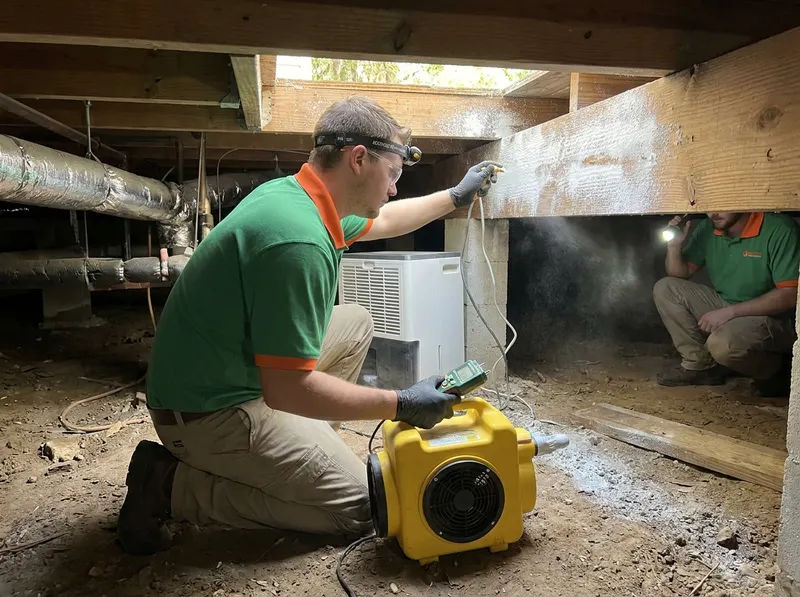
Crawl space moisture & fungus control in Jacksonville addresses the severe structural risks created by Northeast Florida's persistent subtropical humidity, low-elevation water tables, and saturated maritime soil. In historic pier-and-beam properties throughout Riverside, Avondale, and Springfield, unconditioned crawl spaces pull moist air directly from the warm outdoor atmosphere through foundation vents. When outdoor air reaches the cooler subfloor created by interior air conditioning, it condenses rapidly on pine framing, floor joists, and subfloor sheathing. Over sustained periods, structural wood moisture content consistently climbs past 20%, initiating infestations of wood-destroying fungi such as Coniophora puteana (wet rot) and Serpula lacrymans (dry rot), while attracting subterranean termites and moisture-loving wood-boring beetles. Baseline diagnostic evaluations and targeted fungal treatments start at the $200 minimum, with full mitigation calibrated to structural dimensions.
Controlling subfloor humidity requires precise environmental management rather than blind chemical fogging. Technicians measure structural framing moisture using calibrated pin-type meters per ASTM D4444 standards to determine the boundary of microbial growth. Surface fungal colonies are mechanically eliminated from infected joists, after which bare wood members receive targeted applications of disodium octaborate tetrahydrate, an inorganic mineral salt registered under the EPA pesticide standards that creates a permanent barrier against secondary fungal germination and wood-boring insects without off-gassing into interior living areas. Unlike standard cosmetic mold sprays, borate salts penetrate the cellular structure of structural timbers to halt decay without dispersing airborne biocides through floor penetrations into family spaces above.
Ground barrier protection seals exposed damp soil from transferring water vapor directly against structural floor systems. Uncovered sandy loam soils common near the St. Johns River in Ortega, San Marco, and Mandarin continuously release gallons of water vapor daily into enclosed foundation footprints. Technicians install heavy-duty reinforced polyethylene membranes meeting ASTM E1745 Class A vapor retarder specifications, overlapping all seams by a minimum of 12 inches and mechanically securing joints with vapor-proof acrylic seam tape. Where exterior grading directs stormwater runoff toward foundation walls in Southside and Arlington, technicians integrate gravity-fed interior perimeter drain tile systems directing flow to sealed basin sumps compliant with the Florida Building Code for residential crawl spaces.
Subfloor ventilation strategies must be tailored to regional atmospheric dew points. In coastal and riverfront microclimates spanning Oceanway and Fort Caroline, opening crawl space foundation vents during humid summers introduces warm, moisture-laden air that actively condenses against cold subfloor sub-assemblies. Encapsulating the foundation perimeter, permanently sealing foundation vent openings per Department of Energy crawl space guidelines, and operating dedicated, low-amperage crawl space dehumidification equipment maintains subfloor ambient air below 55% relative humidity. Keeping relative humidity below this threshold deprives wood-decaying organisms of the ambient moisture needed to survive, protecting home foundations naturally without reliance on synthetic broad-spectrum pesticides.
Every job gets a firm, written price after a free on-site visit.
Tell us about your crawl space moisture & fungus control job in Jacksonville and we'll send a clear, written quote, usually the same day.
 TerraGuard Insect Services