Northeast Florida coastal humidity and seasonal St. Johns River cresting drive roof rats (Rattus rattus) and Norway rats (Rattus norvegicus) out of marsh flats and directly into residential subfloors. In historic…
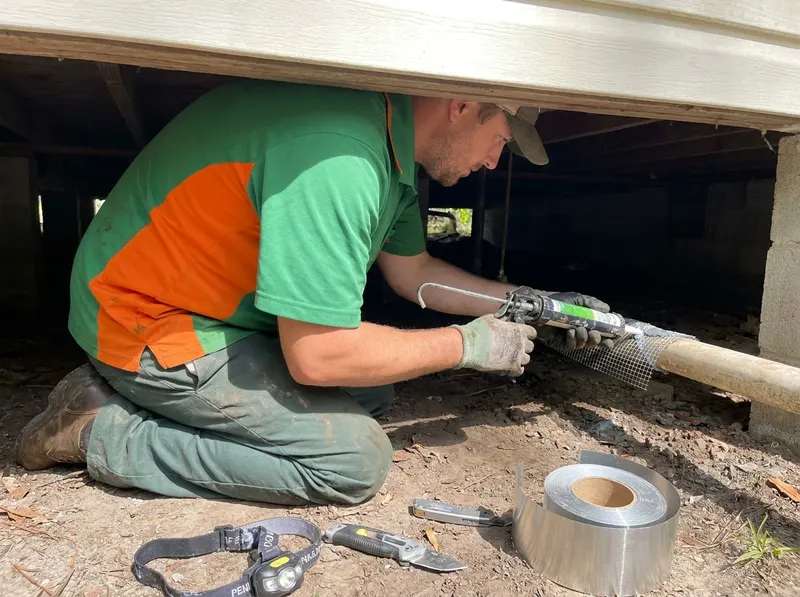
Northeast Florida coastal humidity and seasonal St. Johns River cresting drive roof rats (Rattus rattus) and Norway rats (Rattus norvegicus) out of marsh flats and directly into residential subfloors. In historic pier-and-beam properties throughout Riverside, Avondale, and Springfield, open brick foundation vents provide direct corridors beneath subflooring. Standard chemical baits provide only temporary relief and introduce toxicity into wetland soil ecosystems; architectural exclusion permanently changes the building envelope. Physical sealing establishes a physical defense by securing crawl space entry points using 1/4-inch ASTM International standard galvanized wire cloth, elastomeric structural sealants, and custom-cut metal flashing that rodents cannot chew through.
Subfloor humidity in Duval County regularly exceeds 70%, which rots framing lumber and draws outdoor pests indoors. Sealing a crawl space requires a balanced environmental approach. Technicians install heavy-duty 12-mil to 20-mil polyethylene vapor retarders compliant with the U.S. Department of Energy standards across exposed sandy soil, overlapping every seam by 12 inches and anchoring sheets directly to foundation piers. For unvented enclosures, technicians verify compliance with International Code Council crawl space ventilation guidelines, preventing ground condensation without trapping ambient dampness. In neighborhoods like San Marco, Ortega, and Mandarin, where high water tables saturate soil after tropical depressions, sealing ground moisture out of the foundation preserves structural wood integrity and halts microbial decay.
Rodent exclusion fits residential properties showing exterior gnaw marks, attic droppings, or damaged subfloor insulation, whereas simple interior trapping fits only isolated incidents where all exterior gaps are verified closed. The primary trade-off involves upfront installation cost versus recurring chemical maintenance: structural sealing requires higher initial materials investment, but it eliminates perpetual pesticide exposure and protects municipal groundwater feeding into the Florida Department of Environmental Protection protected tributaries. Work across Arlington, Oceanway, and Southside follows Centers for Disease Control and Prevention environmental hygiene protocols to sanitize rodent harborage areas safely.
Technicians adhere strictly to structural standards established by the Florida Department of Transportation for physical access safety and coordinate remediation aligned with U.S. Environmental Protection Agency integrated pest management principles. Materials meet rigid flame-spread ratings outlined by the National Fire Protection Association to ensure subfloor foam barriers do not introduce fire hazards. Field technicians wear protective respirators verified under Occupational Safety and Health Administration air-quality safety standards when removing bio-waste, while all biological materials undergo safe disposal according to the Florida Department of Agriculture and Consumer Services regulatory directives.
Every job gets a firm, written price after a free on-site visit.
Tell us about your rodent exclusion & crawl space sealing job in Jacksonville and we'll send a clear, written quote, usually the same day.
 TerraGuard Insect Services