Northeast Florida's intense maritime heat index accelerates hymenoptera colonies from mid-spring through late November. In coastal wetland areas near the Timucuan Ecological and Historic Preserve and dense canopy zones…
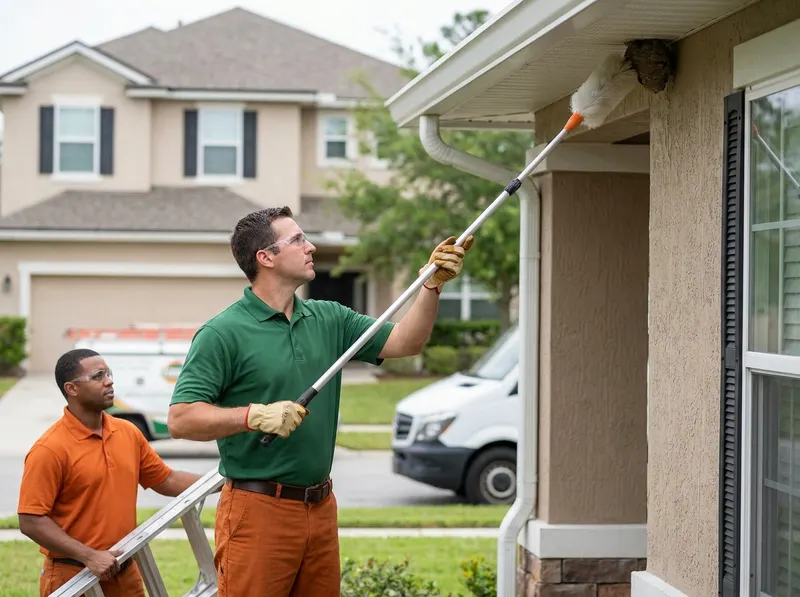
Northeast Florida's intense maritime heat index accelerates hymenoptera colonies from mid-spring through late November. In coastal wetland areas near the Timucuan Ecological and Historic Preserve and dense canopy zones like Mandarin and Ortega, paper wasps (Polistes dominula) and aerial hornets establish nests beneath structural fascia, inside crawlspace vents, and across open eaves. Broad-spectrum aerosol foggers disperse rapidly in humid river winds and leave active brood cells intact inside deep wall voids. Professional mitigation involves locating entry junctions, deploying calibrated desiccant dusts such as diatomaceous earth registered by the Environmental Protection Agency, and mechanically removing secondary combs to eliminate attracting opportunistic scavenging beetles and ants.
Ground-nesting yellow jackets frequently colonize loose, sandy coastal soils along ditch banks, golf course edges, and residential foundation perimeters in Arlington, Southside, and Oceanway. These subterranean colonies often exceed 1,000 workers by late August, creating violent defensive swarms when triggered by residential lawn maintenance vibration. Guidance issued by the University of Florida IFAS Extension highlights that subterranean stinging insect colonies require specialized non-repellent liquid injections or subterranean freeze applications directly down the core gallery. Direct colony isolation protects domestic animals and prevents indiscriminate groundwater leaching into sensitive tributaries of the St. Johns River.
Historic wood-frame structures throughout Riverside, Springfield, and Avondale present specialized structural harborages, specifically unbaffled attic louvers and aged soffits near landmarks like Memorial Park. Stinging insects exploit 1/4-inch architectural breaches to construct internal comb structures between lathe-and-plaster wall bays. Structural extraction prioritizes low-impact access through precise interior drilling or exterior soffit unfastening, followed by high-efficiency particulate air (NIOSH-rated) vacuum collection of the adult insects and total physical removal of larval comb. The intervention concludes with structural installation of 1/8-inch copper mesh barriers, aligning with building envelope standards from the International Association of Certified Home Inspectors.
Ecological consideration dictates species verification prior to any removal protocol. Native pollinators like bumblebees and honey bees require non-lethal management or live apiary relocation under policies managed by the Florida Department of Agriculture and Consumer Services, distinct from the immediate eradication warranted by aggressive baldfaced hornets. Field technicians follow work-safety standards set by the Occupational Safety and Health Administration and pest management frameworks published by the National Pest Management Association, ensuring ladder safety and appropriate personal protective garments up to 30 feet above grade. Property owners can reach TerraGuard Insect Services directly at (904) 242-1004 for confirmed diagnostic evaluations, or text a photograph of the structural void for prompt assessment.
Every job gets a firm, written price after a free on-site visit.
Tell us about your stinging insect removal job in Jacksonville and we'll send a clear, written quote, usually the same day.
 TerraGuard Insect Services