Subterranean termite control in Northeast Florida requires structural environmental engineering rather than random surface spraying. The moist, sandy soils throughout Riverside, San Marco, and Mandarin create ideal…
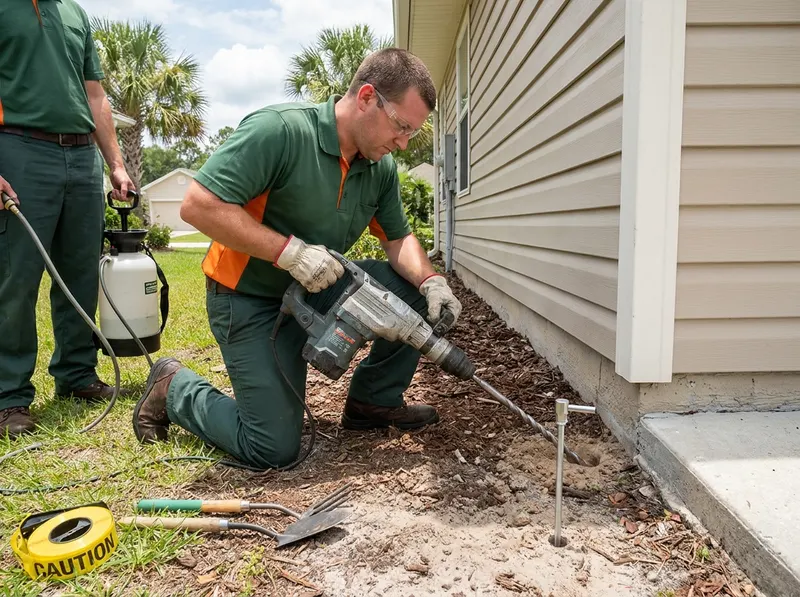
Subterranean termite control in Northeast Florida requires structural environmental engineering rather than random surface spraying. The moist, sandy soils throughout Riverside, San Marco, and Mandarin create ideal conditions for subterranean galleries. Formosan colonies routinely establish massive populations exceeding one million foraging insects, which tunnel beneath driveways and foundation footings. A preventative liquid application establishes an undetectable barrier using non-repellent active chemistries regulated under the EPA Pesticide Programs. Foraging workers cross through this non-repellent treated zone, pick up the compound on their cuticles, and unwittingly transfer the active agent throughout the subterranean nest via social grooming, causing total colony elimination within 60 to 90 days.
Selecting the correct control strategy depends entirely on foundation architecture and moisture exposure. Crawlspace foundations common in historic Springfield and Avondale bungalows require a combined approach: continuous trenching along interior and exterior foundation piers paired with directional sub-slab injection beneath exterior porches. Monolithic slab homes built across Southside, Arlington, and Oceanway require perimeter continuous liquid barriers coupled with exterior bait arrays placed at 10- to 15-foot intervals. Standards established by the Florida Department of Agriculture and Consumer Services (FDACS) Chapter 5E-14 dictate specific liquid application volumes of 4 finished gallons per 10 linear feet per foot of depth. Technicians verify soil profile compositions, as sandy loam allows rapid liquid dispersion, while heavy clay pockets near the Timucuan Ecological and Historic Preserve and coastal marsh drainage basins require slow-dosing vertical rods to prevent runoff into shallow water tables.
Subterranean termite defense differs fundamentally from drywood termite remediation. Drywood termites live entirely inside dry structural framing and require targeted wood injections or whole-structure fumigation, whereas subterranean species maintain mandatory ground contact to replenish moisture. Attempting to manage subterranean colonies with localized surface aerosol sprays drives the colony into uninspected framing voids, compounding structural damage. According to structural research documented by the University of Florida Entomology Department, native subterranean colonies ingest structural cellulose along the wood grain, packing galleries with native soil and fecal material. Liquid treatments remain chemically active in undisturbed soil profiles for 5 to 8 years, while exterior monitoring stations require bi-monthly or quarterly checks to detect foraging spikes before insects breach exterior wall perimeters.
Technicians adjust protocols when treating historic brick pier footers near the St. Johns River in Ortega, where shallow aquifers restrict deep chemical trenching under rules outlined by the Florida Department of Environmental Protection. In sensitive riverfront zones, non-invasive bait matrices containing chitin synthesis inhibitors like noviflumuron or hexaflumuron serve as the primary containment method. As workers ingest the bait, it halts the molting process, collapsing the nest without introducing broad-spectrum runoff hazards. Guidelines from the National Pest Management Association recommend yearly comprehensive inspections to verify structural clearance, monitor drainage slopes, and confirm that landscape mulch does not bridge the protective soil barrier above foundation slab levels.
Every job gets a firm, written price after a free on-site visit.
Tell us about your subterranean termite treatment job in Jacksonville and we'll send a clear, written quote, usually the same day.
 TerraGuard Insect Services